Closing the month faster: six fixes for the gap between the last load and month-end
Six fixes a mine site can make this month, with or without software, so a shift's numbers stop waiting for month-end. With a printable check to run on your last shift.
Answer summary
A shift's numbers reach the office one piece at a time, and month-end is spent matching them. Six fixes a site can make this month, with or without software: one fleet number on every form, loads captured at the face, one date rule for the night shift, job cards closed the same day, fuel captured as it happens, and a weekly report.
Every shift ends with a last load, and by the next morning the site knows what that shift moved. What it cost waits for month-end.
In between, the pieces of the shift reach the office one at a time, each on its own day.
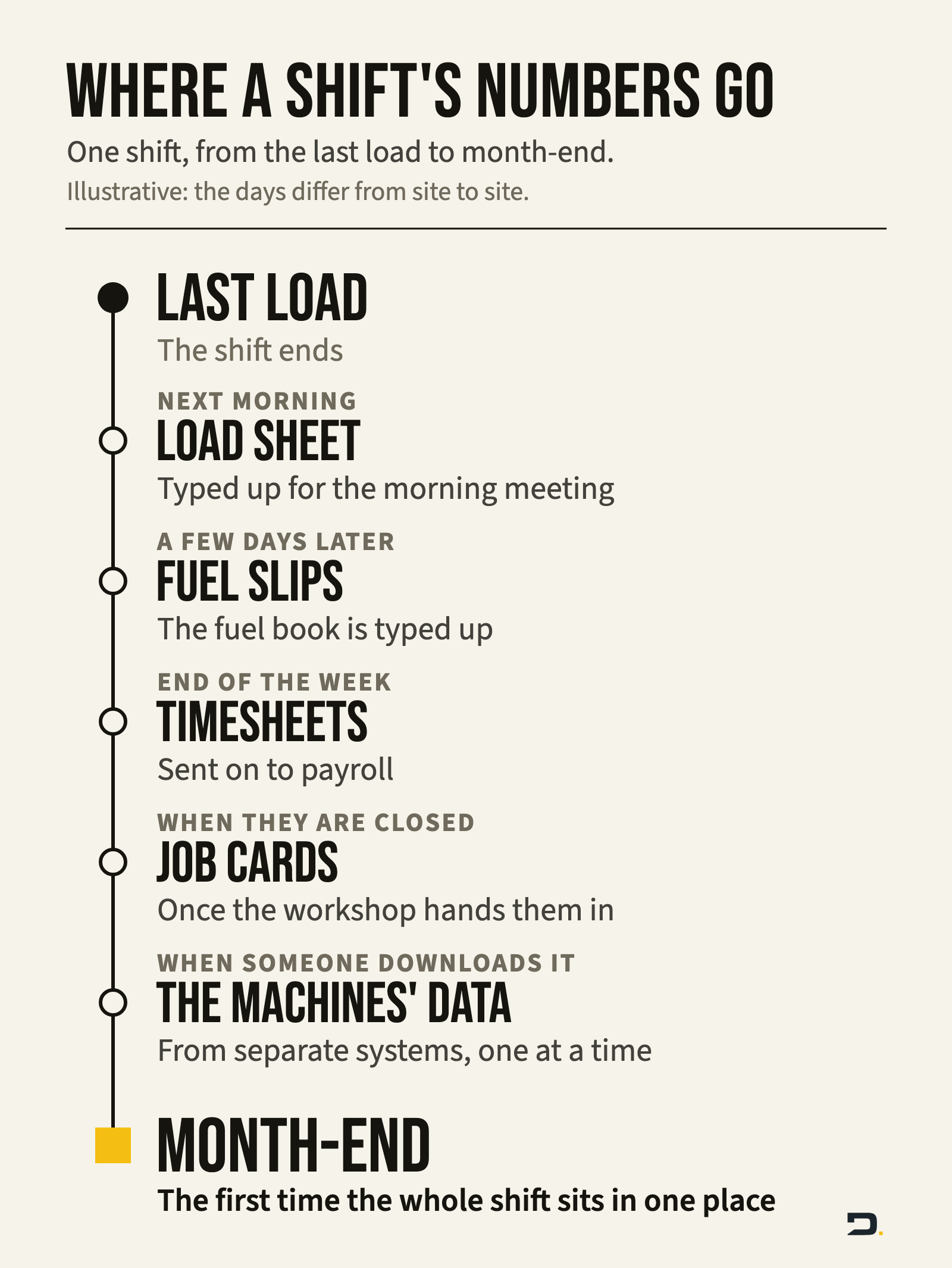
Where the time goes
Most of it goes on matching the pieces to each other, and on chasing the ones that are missing. Someone in the office types each piece up again. When two pieces disagree, they phone or WhatsApp whoever was on shift, days after it ended.
At month-end, the office does that for the whole month at once. The figures that come out of it can drift from what happened on the ground.
Six fixes a site can make this month
Each one works with or without software. The first five come down to recording each piece once, at the time, against the same machine and the same date. The sixth keeps it happening.
- One fleet number on every form. The load sheet, the fuel slip, the job card and the timesheet should all name a machine the same way. When one says ADT01, another gives a serial number and a third gives only the operator, someone matches them by hand. Use the fleet number painted on the machine, everywhere.
- Capture loads at the face, during the shift. The loader operator writes down each load as the truck leaves the face, against its fleet number, with each delay and its reason. The foreman adds who ran each machine and for how long. A tally written up after the shift comes from memory.
- One rule for which date the night shift belongs to. A night shift crosses midnight, so the load sheet can date it by the day it started and the fuel book by the day it ended. Agree one rule, such as the date the shift started, and print it on every form.
- Close job cards the day the machine goes back to work. An open job card holds the hours the machine stood and the parts it took. Left open, it turns up at month-end, when the parts are priced and the job is long past. Have the mechanic close it that day, with the hours and the parts written in.
- Capture fuel as it happens. Record each fill at the bowser when it is made: the fleet number, the litres and the time. Send the day's fills to the office that day, so the site manager can read each shift's diesel beside its loads. A fuel book typed up days later is hard to set against the shift that used the diesel.
- A weekly report instead of waiting for month-end. Put out a short report every Monday with the loads, the diesel, the standing time and the open job cards. A weekly report drives discipline and behaviour. Once a missing fuel entry or an open job card gets asked about every Monday, people start completing them on the day.
The last shift check
Before changing anything, find out where your own gap is. Take the last shift, pick one truck or loader, and answer the five questions on the card.
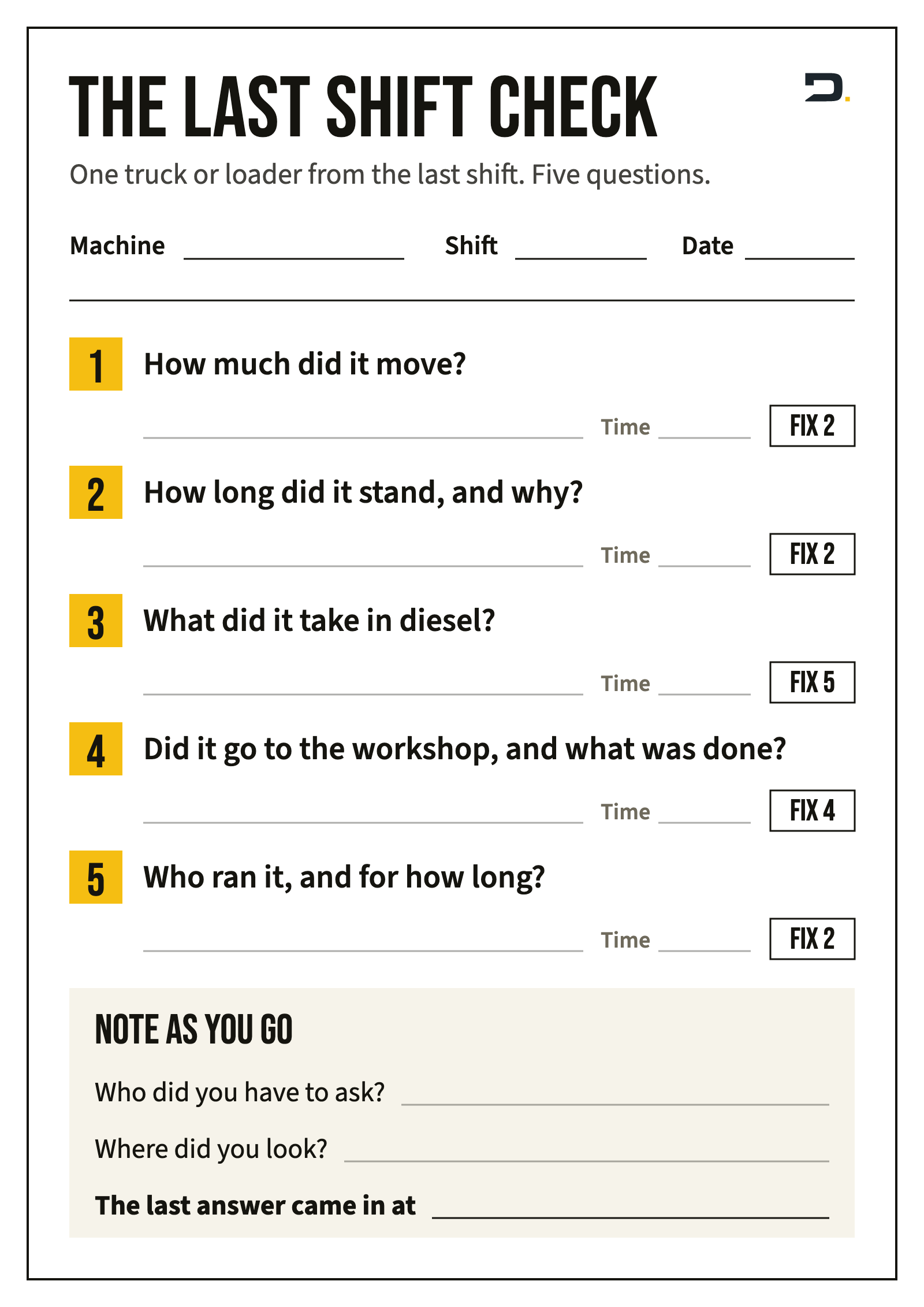
Write down the time each answer came in. The one that came in last shows where to start, and the card names the fix each question belongs to. The card is also a one-page PDF for printing.
Run the check again a month later, on another machine, and compare the times.
At Diggy, we built our system around recording each piece once, as the work happens. Operators, supervisors, the workshop and the fuel bay record their part in it as they work, on mobile apps that work offline. Diggy is one system for the whole field operation: production, machines, fuel, maintenance, parts and people. You get the answer straight away, with its source, so you can act before the money is spent. Diggy was built around AI from the start, by Cambridge engineers. It works across everything that is connected, which is why the answer comes straight away.
Sources
- O. Pasch and S. Uludag, "Optimization of the load-and-haul operation at an opencast colliery", Journal of the Southern African Institute of Mining and Metallurgy (SAIMM), vol. 118 no. 5, May 2018
- H. Durrant-Whyte, R. Geraghty, F. Pujol and R. Sellschop, "How digital innovation can improve mining productivity", McKinsey & Company, 1 November 2015